Enhanced 360-Degree Panorama Synthesis: Leveraging Smartphone Sensors and Semantic-Driven Neural Architecture
Yu-Wen Liu Nien-Hsin Tseng Hsin-Chang Yu Yu-Ting WuNational Taipei University
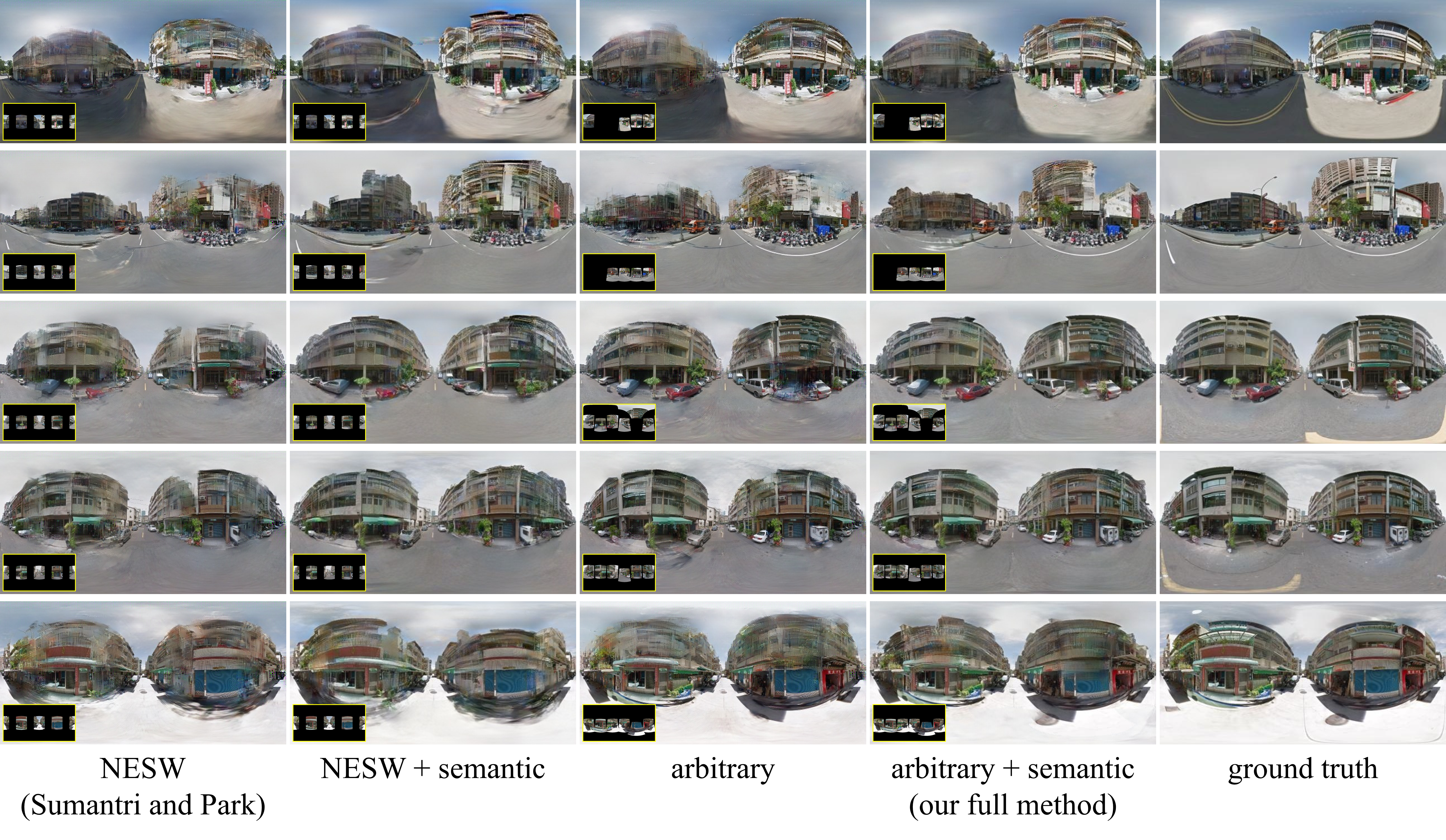
Qualitative comparisons of different input strategies and network architecture configurations. Relying on NESW NFoV inputs can lead to missing important scene features, while inferring missing regions without semantic guidance often results in blurred boundaries. In contrast, our full method, utilizing arbitrary NFoV inputs and a semantic-driven panorama completion network, achieves the highest quality panoramas.
Abstract
360-degree imagery offers immersive multimedia experiences but remains challenging for non-experts to acquire. This paper introduces a novel framework for synthesizing high-fidelity 360-degree panoramas from partial panoramas constructed from arbitrary normal-field-of-view (NFoV) images. Our method leverages inertial and orientation data from smartphone sensors to infer spatial configurations, enabling flexible image capture. To improve synthesis quality, we propose a saliency-aware view selection strategy that reduces the discrepancy between synthesized training data and inference-time inputs. Additionally, we introduce a data augmentation technique, termed circular padding, and integrate it into a semantics-guided NFoV outpainting framework to extend its capability to 360-degree panoramic synthesis while preserving boundary continuity. Both quantitative and qualitative results show that our method produces panoramas with superior visual realism and structural coherence compared to existing learning-based approaches.
Publication
Yu-Wen Liu, Nien-Hsin Tseng, Hsin-Chang Yu, Yu-Ting Wu.
Enhanced 360-Degree Panorama Synthesis: Leveraging Smartphone Sensors and Semantic-Driven Neural Architecture.
Journal of Information Science and Engineering (JISE), to appear. BibTeX (coming soon)
JISE paper (coming soon)
Digital library (coming soon)
Last Update: December 2025